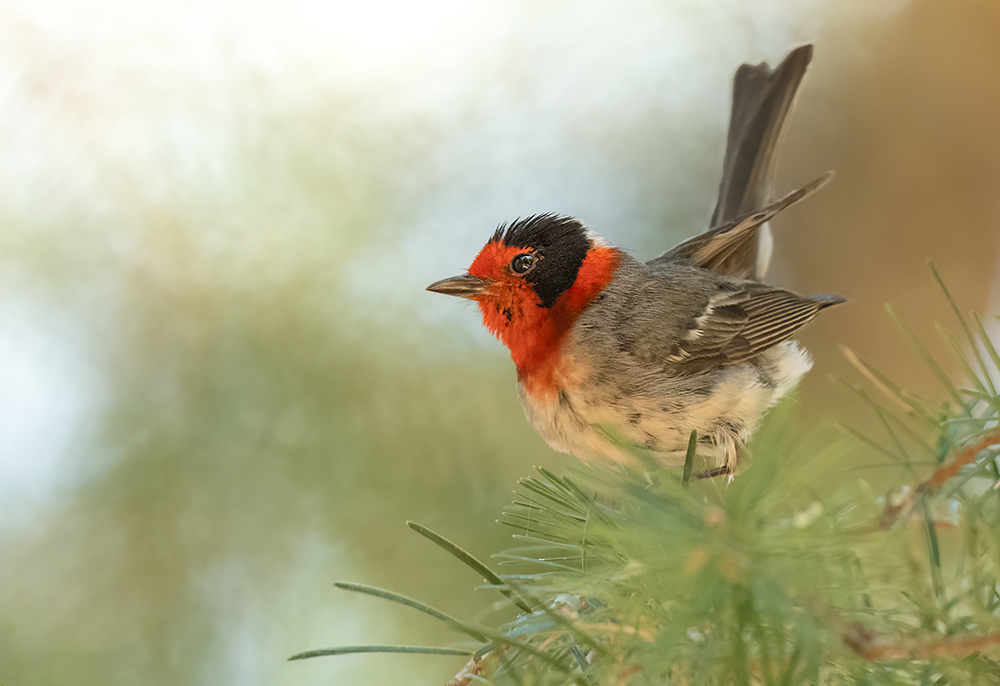
Arizona supports an exceptionally varied assemblage of wood warblers (family Parulidae), representing both western and eastern lineages that meet in the state’s “sky-island” mountain ranges and riparian corridors. Among the common breeders are the Yellow Warbler (Setophaga petechia), Lucy’s Warbler (Leiothlypis luciae), Grace’s Warbler (Setophaga graciae), Virginia’s Warbler (Leiothlypis virginiae), and the brilliant Red-faced Warbler (Cardellina rubrifrons). The Black-throated Gray Warbler (Setophaga nigrescens) nests widely in oak and pinyon-juniper woodlands, while the Yellow-rumped Warbler (Setophaga coronata), in both auduboni and coronata forms, is a widespread migrant and local breeder in montane forests.
Other species occurring regularly in migration include the Orange-crowned (Leiothlypis celata), Nashville (Leiothlypis ruficapilla), Tennessee (Leiothlypis peregrina), MacGillivray’s (Geothlypis tolmiei), Townsend’s (Setophaga townsendi), Hermit (Setophaga occidentalis), Wilson’s (Cardellina pusilla), Black-throated Blue (Setophaga caerulescens), Hooded (Setophaga citrina), Yellow-throated (Setophaga dominica), and American Redstart (Setophaga ruticilla). The Common Yellowthroat (Geothlypis trichas) is a year-round resident of wetlands statewide, and both Northern (Parkesia noveboracensis) and Louisiana Waterthrushes (Parkesia motacilla) appear along shaded mountain streams during migration.
Specialties of Arizona’s southern sky islands include the Rufous-capped Warbler (Basileuterus rufifrons), an uncommon but now established breeder in canyons of the Huachuca and Santa Rita Mountains, and the spectacular Painted Redstart (Myioborus pictus), which nests along shaded montane streams and often fans its tail while foraging. The Olive Warbler (Peucedramus taeniatus), though no longer classified within Parulidae, is a characteristic member of Arizona’s high-elevation pine forests, while the Yellow-breasted Chat (Icteria virens), likewise now placed in its own family Icteriidae, remains a familiar summer resident of dense riparian thickets. Collectively, these species—ranging from desert-adapted Lucy’s Warblers to canopy-dwelling Grace’s and conifer-loving Olive Warblers—reflect Arizona’s extraordinary ecological range, making spring and fall migration periods some of the most vibrant birding seasons in North America.
Arizona hosts an impressive list of rare and vagrant warblers—species that appear only occasionally during migration, after storms, or as exceptional wanderers far outside their typical ranges. Southern vagrants such as Fan-tailed Warbler (Basileuterus lachrymosus) and Crescent-chested Warbler (Oreothlypis superciliosa) originate from Mexico’s montane forests and are among the state’s most sought-after rarities. Eastern warblers make up the majority of records, including Canada (Cardellina canadensis), Kentucky (Geothlypis formosa), Mourning (Geothlypis philadelphia), Worm-eating (Helmitheros vermivorum), Swainson’s (Limnothlypis swainsonii), and Connecticut Warbler (Oporornis agilis), all typically found as isolated migrants in fall. Brightly colored canopy species such as Prothonotary (Protonotaria citrea), Bay-breasted (Setophaga castanea), Blackburnian (Setophaga fusca), Magnolia (Setophaga magnolia), Chestnut-sided (Setophaga pensylvanica), Black-throated Green (Setophaga virens), Cape May (Setophaga tigrina), Cerulean (Setophaga cerulea) and Golden-winged (Vermivora chrysoptera) appear sporadically, most often following weather events that push migrants westward. High-latitude travelers such as Blackpoll (Setophaga striata), Palm (Setophaga palmarum), and Pine Warbler (Setophaga pinus) show up irregularly, usually at riparian oases or urban parks. Southwestern surprises include Slate-throated Redstart (Myiothlypis leucotis), recorded only in exceptional years, and Tropical Parula (Setophaga pitiayumi) and Northern Parula, both rare but nearly annual. Ground-oriented species—Ovenbird (Seiurus aurocapilla)—occur as low-frequency migrants in shady canyons or well-watered habitat. Finally, the Prairie Warbler (Setophaga discolor) appears most often as a spring or fall vagrant.