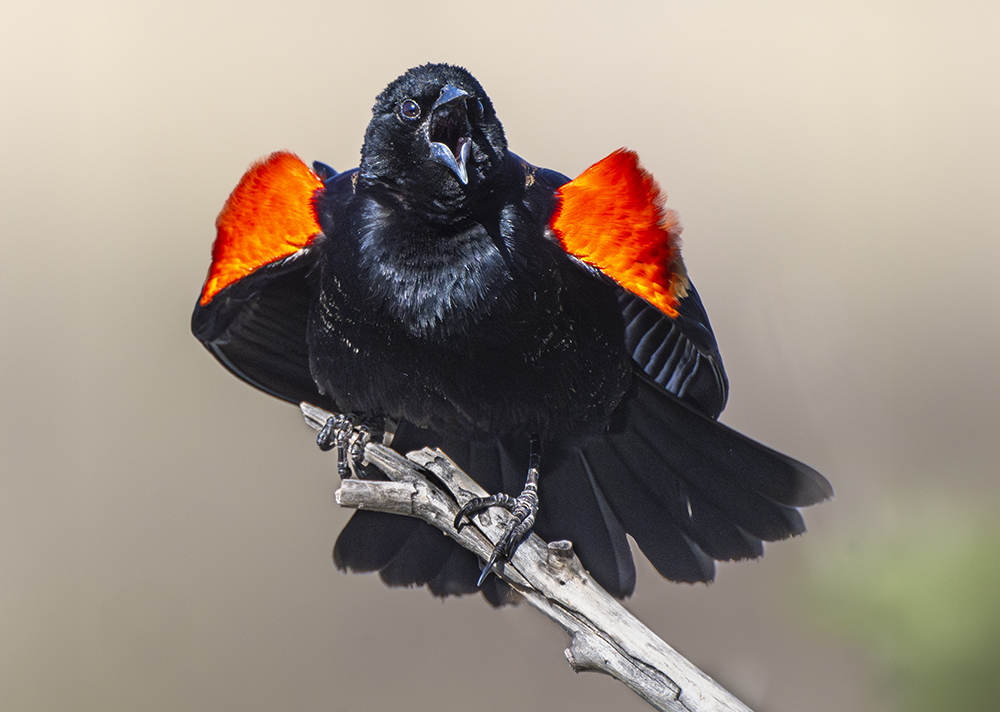
Arizona’s icterids—blackbirds, orioles, and meadowlarks—form a colorful and diverse group across the state’s wetlands, deserts, and grasslands. The Red-winged Blackbird (Agelaius phoeniceus) is abundant in marshes, males showing scarlet and yellow shoulder patches while females are streaked and brown. The striking Yellow-headed Blackbird (Xanthocephalus xanthocephalus) nests in cattail marshes, and the smaller Brewer’s Blackbird (Euphagus cyanocephalus) is common in fields, towns, and feedlots. The Rusty Blackbird (Euphagus carolinus) occurs rarely in winter. Arizona’s cities and farmlands resound with the loud calls of the Great-tailed Grackle (Quiscalus mexicanus), males long-tailed and iridescent while females are smaller and brown. Brood-parasitic Brown-headed Cowbirds (Molothrus ater) are widespread, while the stockier Bronzed Cowbird (Molothrus aeneus), with red eyes and a hunched stance, reaches into southern Arizona from Mexico.
Orioles add brilliance to desert towns and mountain slopes. The Hooded Oriole (Icterus cucullatus), slim and orange with a black throat, favors palm trees in lowland neighborhoods. The Bullock’s Oriole (Icterus bullockii), orange with a black crown and white wing patch, breeds along riparian woodlands. The lemon-yellow and black Scott’s Oriole (Icterus parisorum) is tied to yucca-rich slopes in central and southeastern uplands. Less common are the Orchard Oriole (Icterus spurius), a scarce migrant, and rarities such as Baltimore Oriole (Icterus galbula), Altamira Oriole (Icterus gularis), and Streak-backed Oriole (Icterus pustulatus), occasional wanderers from the east or south.
Meadowlarks, though closely related to blackbirds, represent the grassland voice of Arizona. The Western Meadowlark (Sturnella neglecta) is widespread, its flutelike, gurgling song a familiar sound of pastures and desert valleys. The Eastern Meadowlark (Sturnella magna) is scarce, mostly in winter in southeastern Arizona, its whistled notes sharper than those of Western. Of special interest is the recently recognized Chihuahuan Meadowlark (Sturnella lilianae), now a full species distinct from Eastern. It breeds in the high desert prairies of the San Rafael Valley and other southeastern grasslands, its thinner, sweet song setting it apart from its relatives.