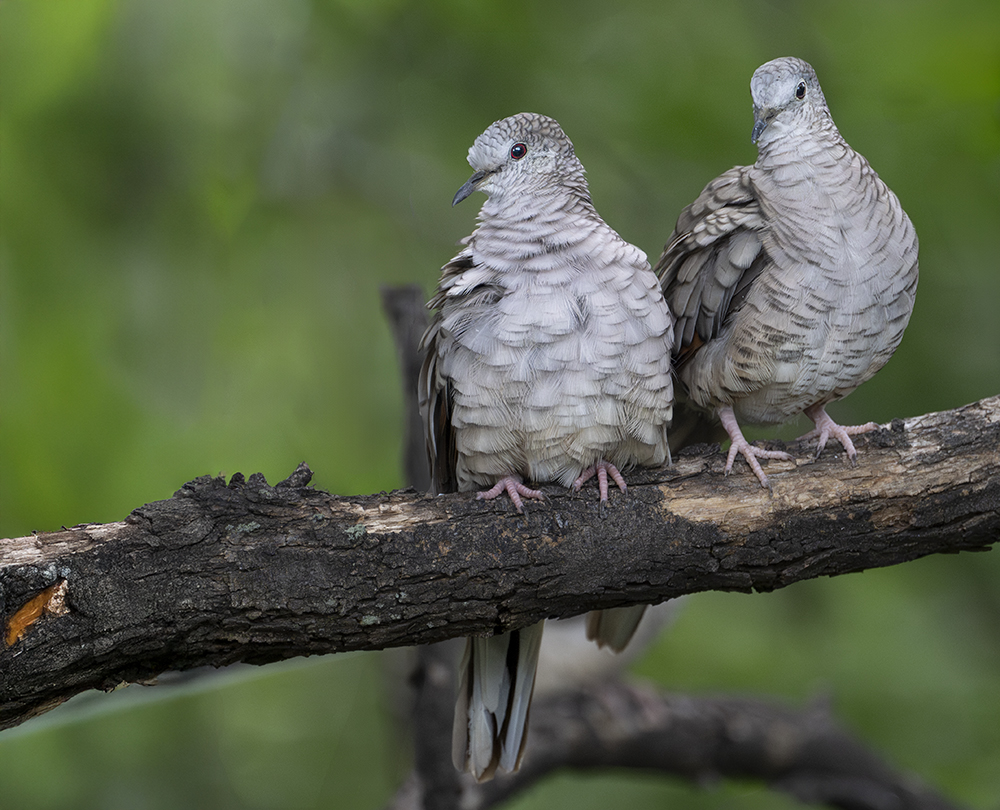
Inca Doves
Arizona hosts a wide variety of pigeons and doves, both native and introduced. The Rock Pigeon (Columba livia), originally from Europe, is now established around cities, towns, and farms, easily recognized by its gray plumage, wing bars, and iridescent neck. Among the most familiar native species, the Mourning Dove (Zenaida macroura) is abundant statewide in deserts, grasslands, and agricultural areas, its soft calls a common sound of the landscape. The White-winged Dove (Zenaida asiatica), a hallmark of the Sonoran Desert, is especially notable in summer when large flocks gather to feed on saguaro cactus fruit, later migrating south. Another widespread species is the Eurasian Collared-Dove (Streptopelia decaocto), an introduced bird that expanded rapidly through Arizona beginning in the 1990s; pale gray with a distinct black collar, it thrives in towns and agricultural areas. Smaller doves add to the diversity: the Inca Dove (Columbina inca), with scaled gray plumage, is common in southern and central cities and suburbs; the Common Ground-Dove (Columbina passerina) occurs in desert washes and brushy farmlands, its rising coo distinctive; and the Ruddy Ground-Dove (Columbina talpacoti), though rare, occasionally strays into southern Arizona from Mexico. In higher elevations, particularly the forested “sky islands,” the Band-tailed Pigeon (Patagioenas fasciata) appears in summer, a large dove with a purplish head and pale neck band. Together these species make Arizona one of the richest states for Columbidae diversity in the U.S., with Mourning Dove, White-winged Dove, Rock Pigeon, Eurasian Collared-Dove, and Inca Dove the most widespread, while the rarer Band-tailed Pigeon, Common Ground-Dove, and Ruddy Ground-Dove provide highlights for birders in southern and montane regions.