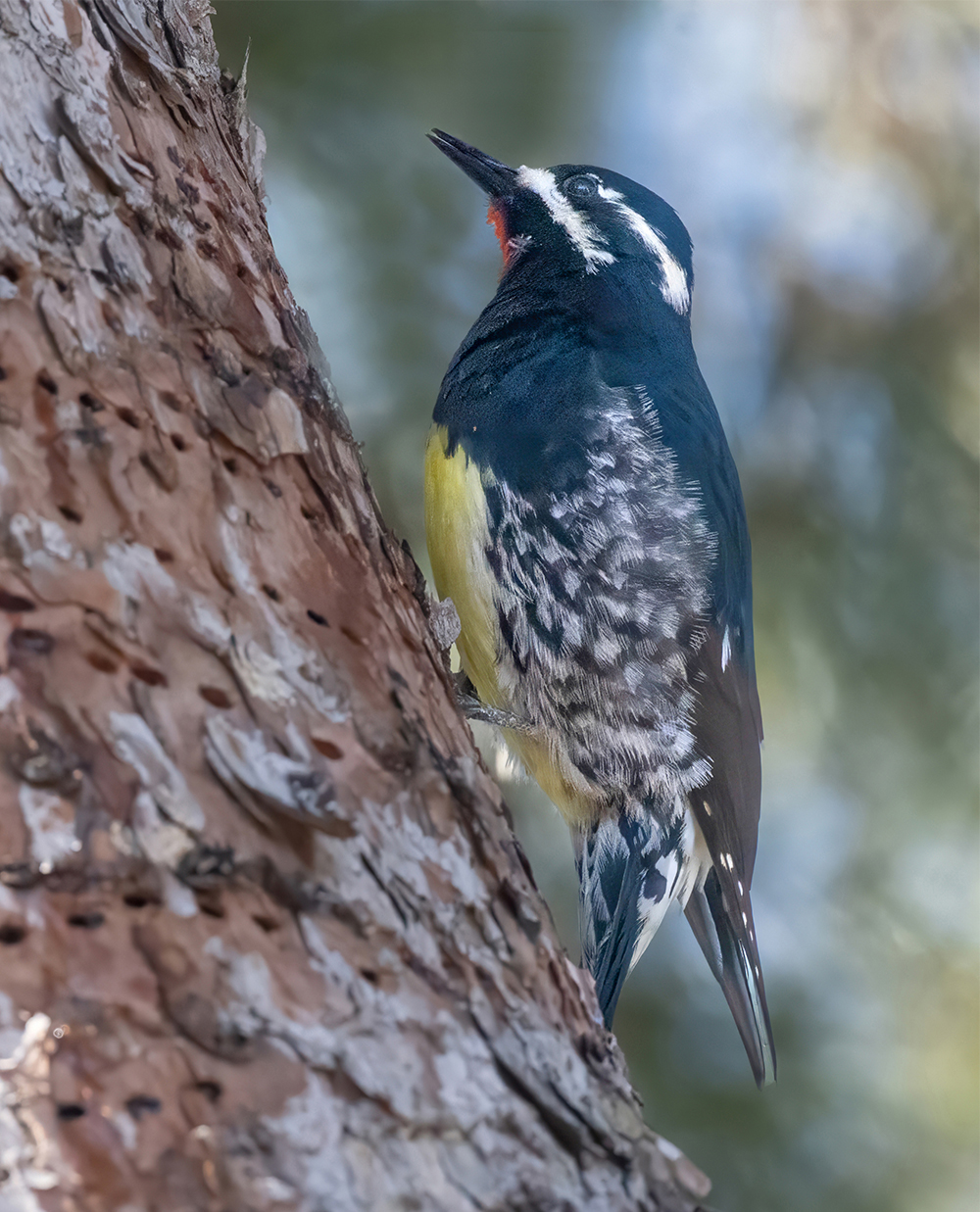
Williamson’s Sapsucker is a striking and somewhat uncommon woodpecker in Arizona, most often found in the higher-elevation coniferous forests of the Mogollon Rim, White Mountains, and sky island ranges of the southeast. Unlike most woodpeckers, this species shows pronounced sexual dimorphism: males are boldly patterned with a black back, head, and breast, bright yellow belly, and a red throat patch, while females are mottled brown and black with a barred back and a pale rump.
In Arizona, Williamson’s Sapsuckers breed in mature mixed-conifer and aspen forests, where they excavate nest cavities in large-diameter trees, often aspens. Their feeding habits center on drilling sap wells in conifers and aspens, consuming both sap and the insects attracted to it, but they also forage for ants, beetles, and berries. They are generally altitudinal migrants, nesting in higher mountain forests during summer and moving downslope to oak-pine woodlands and lower conifers in winter, though some remain year-round in suitable habitats.
Though not considered rare, Williamson’s Sapsuckers are more localized than other Arizona woodpeckers, and their presence is closely tied to healthy high-elevation forests. Their reliance on aspen groves and older trees for nesting highlights the importance of conserving Arizona’s mountain habitats for sustaining their populations.