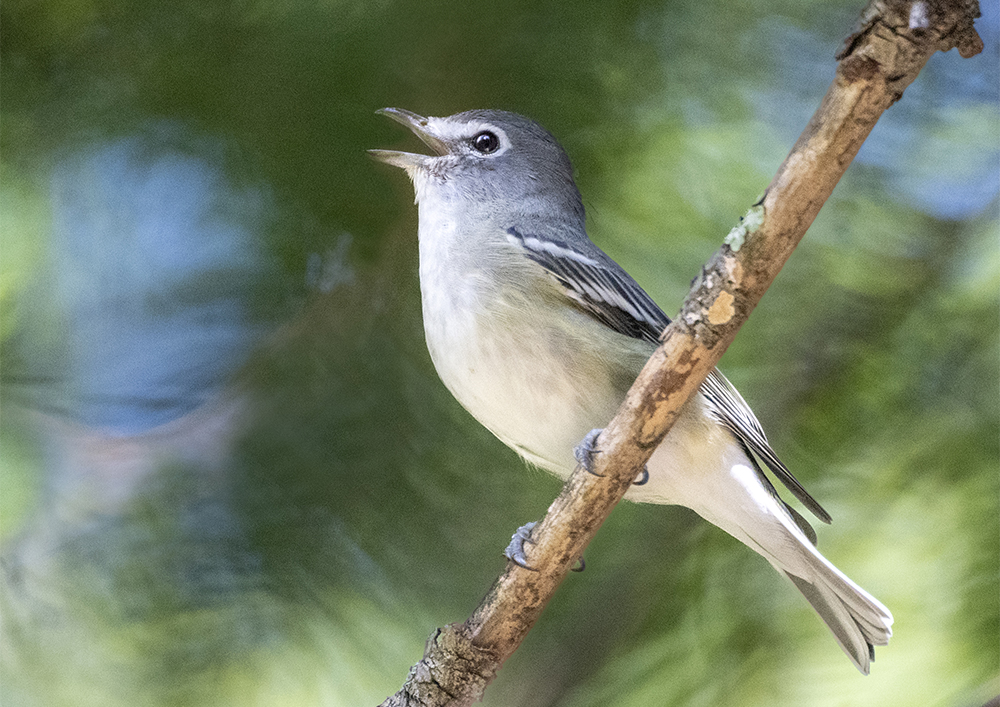
The Plumbeous Vireo is a small, grayish songbird found throughout much of Arizona, especially in montane woodlands and mixed conifer–oak habitats. Its plumage is characterized by a lead-colored gray head and back, whitish underparts, and two bold white wing bars. A distinct whitish “spectacle” surrounds the eye, giving it a striking facial pattern.
In Arizona, Vireo plumbeus breeds primarily in the higher elevations of the Mogollon Rim, the White Mountains, the Chiricahua Mountains, and other Sky Island ranges, favoring pinyon–juniper, oak, and pine woodlands. They are most often encountered during the breeding season from April through September, when males deliver a persistent, burry song to defend territories and attract mates. Outside the breeding season, many individuals migrate southward into Mexico and Central America, though some may linger later into the fall.
Diet consists largely of insects and other arthropods gleaned from foliage, supplemented with berries and other small fruits. Their foraging behavior is deliberate, moving slowly through branches while carefully inspecting leaves. Nests are compact cups of plant fibers and spider silk, suspended from the forks of twigs. Both parents share in feeding the young.
Although not considered rare in Arizona, Vireo plumbeus populations can be locally affected by habitat loss from logging, fire suppression, and development. Nonetheless, their distinctive appearance and steady singing make them a familiar presence in Arizona’s upland forests each summer.